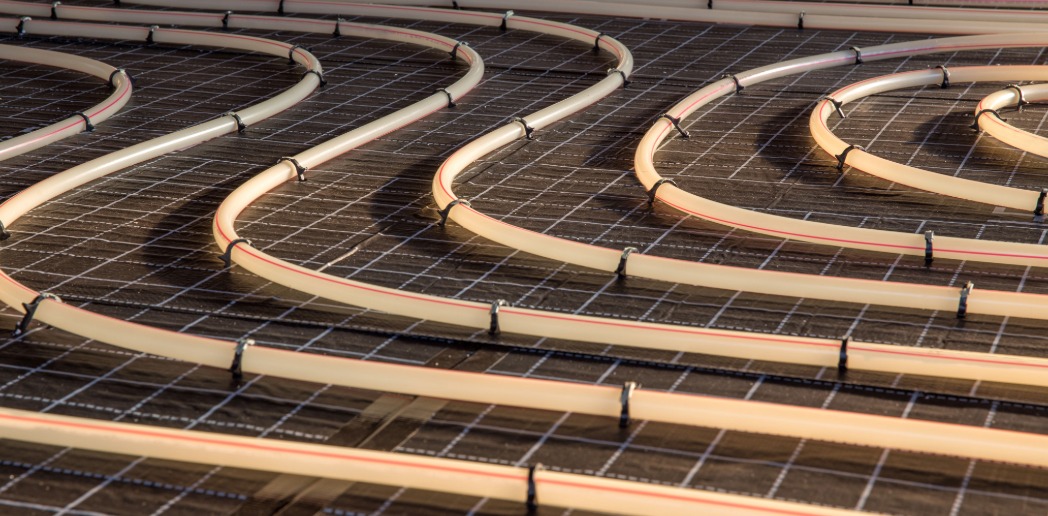
Engineered Wood Flooring Over Radiant Heat: Why Construction Matters
Radiant heat beneath a real hardwood floor is one of today's most desirable home features, but it also creates one of the most demanding environments a wood floor will ever experience. Daily heating cycles and seasonal humidity changes place continuous stress on the flooring, making its engineering just as important as its appearance.
Wood is a hygroscopic material that continually gains and loses moisture as its environment changes. Radiant heat accelerates this natural process by warming the floor from below, increasing moisture loss during dry winter months. As the wood dries, it shrinks, creating stresses that can lead to gaps, checking, splits, dry cupping, or even structural failure. Although engineered wood flooring is significantly more dimensionally stable than solid hardwood, not all engineered floors are constructed alike. Core construction, wear layer thickness, adhesive bonds, and tongue-and-groove design all influence long-term performance.
Proper Installation Comes First
Every successful hardwood floor installation over radiant heat begins with a stable environment. Proper commissioning of the radiant system, moisture testing, acclimation, and maintaining consistent interior temperature and relative humidity are essential. No wood floor, regardless of its construction, can perform as intended without proper environmental control and installation. Once those conditions are met, selecting the right engineered floor becomes equally important.
Core Construction
The core is the foundation of every engineered hardwood floor and one of the most important factors in its performance over radiant heat.
Many engineered floors use multi-ply Baltic birch plywood cores. While these perform well under normal conditions, their numerous rotary-peeled veneers and adhesive bond lines are more susceptible to stress from repeated heating and seasonal humidity changes. As the floor dries from below, differential movement between the plies can contribute to dry cupping and, in extreme cases, increase the potential for core delamination.
Premium engineered wood flooring instead uses a solid, quartersawn hardwood core engineered for exceptional dimensional stability. Without internal veneer layers or glue lines, there is no risk of ply separation or core delamination. Because quartersawn hardwood expands and contracts less across its width than plainsawn or rotary-peeled wood, it responds more predictably to radiant heat and seasonal humidity changes. Combined with a precision-machined tongue-and-groove profile, this balanced construction maintains mechanical engagement while resisting dry cupping.
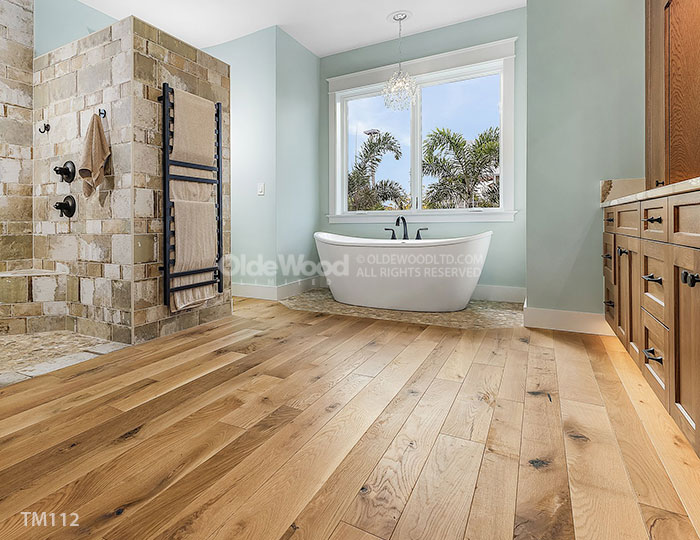
Olde Wood Ltd Mountain Oak available in engineered format, designed to perform over radiant heat.
Wear Layer (Lamella)
The wear layer must also be engineered as part of a balanced flooring system. While a thicker lamella provides greater refinishing potential, it can also develop greater shrinkage forces as moisture is lost. Under prolonged radiant heat and low humidity, these stresses can contribute to checking, face splitting, dry cupping, and surface distortion.
Premium engineered wood flooring balances wear layer thickness with core construction and backing to maximize both durability and dimensional stability. For this reason, premium manufacturers generally use wear layers between 4mm and 6mm, providing an optimal balance of refinishing capability, stability, and long-term performance.
Tongue-and-Groove Profile
The tongue-and-groove profile is the engineered connection that locks each board together. A precision-machined profile maintains mechanical engagement while allowing normal seasonal movement without distorting the floor. As humidity decreases and the wood naturally shrinks, it continues to support adjacent boards, helping minimize dry cupping, maintain alignment, and distribute movement across the floor as a unified system rather than as individual boards.
When specifying hardwood flooring over radiant heat, appearance should never be the only consideration. The true measure of quality lies beneath the surface, where the core, wear layer, and the flooring profile function as a complete engineered system. A premium engineered wood floor built with a solid, quartersawn hardwood core, balanced construction, and precision-machined joinery is designed to minimize movement, maintain structural integrity, and withstand the unique demands of radiant heat. The result is a wood floor whose performance is defined not only by what you see on the surface, but by the engineering you never see beneath it.
"Every engineered floor may look similar from above, but what lies beneath the surface is what determines how it performs for decades. That's why construction matters just as much as appearance."
- Brett Miller, Olde Wood Ltd General Manager
Considering wood flooring over radiant heat?
Our design specialists can help you choose a construction built to perform for decades. Get a Free Quote